A type of '[Un]Walling' is possibly happening here:
Source: Interactive Architecture.
'Here’s a great project that came out of the Adapative Architecture and Computation programme at the Bartlett School of Architecture. ‘Adaptive Fa[ca]de’ by Marilena Skavara explores the functional possibilities and performative characteristics of cellular automata (CA). In addition to the unique emergent behaviour of CA, a neural network enables a further computational layer to evolve CA behaviour to the context of its surrounding environment.'
Adaptive fa[CA]de from marilena on Vimeo.
Marilena Skavara's Adaptive fa[CA]de at Digital Hinterlands exhibition, London from marilena on Vimeo.
'Building upon the early work of Conway’s ‘Game of life’ and Stephen Wolfram’s extensive research on the wider implementation of CA, ‘Adaptive Fa[ca]de’ becomes a living adapting skin, constantly training itself from the history of its own errors and achievements. For a more detailed description of the project, read Marilena’s article for Vague Terrain.'
Showing posts with label Spatial Design. Show all posts
Showing posts with label Spatial Design. Show all posts
Tuesday, 16 March 2010

Saturday, 13 March 2010
Moment: Yukihiro Taguchi
Performing Space: Floor becomes wall becomes obstacle becomes seating becomes art object becomes function..... Taguchi spontaneously shifts and documents the contexts of space over time. There is an accompanying text if you follow the link.
Friday, 26 February 2010
More on Unwalling
Source: Boiteaoutils
Baptiste Debombourg

"In this installation series, the wall seems to come into the room, to attack the observer. The deformation of the surface is creating a tension between the solid and the void, and it blurs the limit of the the inner space envelope. The broken surface gives a very strong materiality to the traditional clean walls of the "white cube" and the pieces of wood appearing under the white coating are like scars."
Baptiste Debombourg

"In this installation series, the wall seems to come into the room, to attack the observer. The deformation of the surface is creating a tension between the solid and the void, and it blurs the limit of the the inner space envelope. The broken surface gives a very strong materiality to the traditional clean walls of the "white cube" and the pieces of wood appearing under the white coating are like scars."

Wednesday, 24 February 2010
More On Unwalling
Source: Boiteaoutils
Posting this as the blog seems to be thematically interested in the idea of walls and their un/walling which is a nice tie-in with house theme. However, some of these examples exist within the context of the gallery [as opposed to domestic context] and exists partly as a critique of the 'white cube' ideology.

Posting this as the blog seems to be thematically interested in the idea of walls and their un/walling which is a nice tie-in with house theme. However, some of these examples exist within the context of the gallery [as opposed to domestic context] and exists partly as a critique of the 'white cube' ideology.

Friday, 12 February 2010
More On Matta Clark and Walls
Source: Boiteaoutils
Yeah...couldn't have said it better myself....
003%5B1%5D.jpg)
002%5B2%5D.jpg)
Yeah...couldn't have said it better myself....
003%5B1%5D.jpg)
"By undoing a building there are many aspects of the social conditions against which I am gesturing: first, to open a state of enclosure which had been preconditioned not only by physical necessity but by the industry that profligates suburban and urban boxes as a context for insuring a passive, isolated consumer-a virtually captive audience. The fact that some of the buildings I have dealt with are in Black ghettos reinforces some of this thinking, although I would not make a total distinction between the imprisonment of the poor and the remarkably subtle self-containerization of higher socio-economic neighborhoods. The question is a reaction to an ever less viable state of privacy, private property, and isolation."
Gordon Matta Clark. Interview by Donald Wall for Arts Magazine. May 1976
002%5B2%5D.jpg)
As I have been observing before on boiteaoutils, a wall is at first nothing more than a line drawn on a piece of paper. This line then acquires a materiality and thus own a violence that prevents bodies a freedom of movement (the climax of this violence is obviously achieved in prisons where four walls surround the body). A wall here is not necessarily to be understood only as a vertical panel but also every kind of built surface that prevents the body from a freedom of movement (floors, walls, fences etc.) Any process of “unwallization” is therefore a resistance to this violence. It is difficult to find architecture that succeeds in applying these kinds of processes; nevertheless, several artists did work on that issue and produced various propositions in that regard. Gordon Matta Clark’s work is both the precursor and the quintessence of them, piercing, sawing, digging, rending, rotating, splitting, tearing apart, Matta Clark mistreats the wall as much as he can and the latter almost loses the totality of its violence in this way.
The wall is a separation device but not necessarily as a surface needing more energy to be penetrated than a human owns, can also be seen in the example of rows of sheets on clothes lines. The wall thus looses its violent status while conserving most of its other characteristics.
All the following pictures come from the book. Gordon Matta Clark. Phaidon 2003.
[Please note: I have two copies of Matta-Clark's books if anyone would like to look at them - Sally]
Tuesday, 9 February 2010
Splitting The Atom: Massive Attack Video
Source: Boiteaoutils
Massive Attack-Splitting the Atom-directed by Edouard Salier from edouard salier on Vimeo.
Massive Attack-Splitting the Atom-directed by Edouard Salier from edouard salier on Vimeo.
Wednesday, 27 January 2010
Phenomenology & Semiotics of House Video Clips
This and the following posts relate to the lecture this morning and couldn't be shown, please check it out here:
Michael Landy on Breakdown
Tornado: The Solid and the Ephemeral
Jean Cocteau: La Belle et la Bette [Beauty and the Beast], 1946
MTV Cribs Episode: Akon
Can't embed this, so here's the link: http://www.youtube.com/watch?v=I7T7np6HetU&feature=related
Michael Landy on Breakdown
Tornado: The Solid and the Ephemeral
Jean Cocteau: La Belle et la Bette [Beauty and the Beast], 1946
MTV Cribs Episode: Akon
Can't embed this, so here's the link: http://www.youtube.com/watch?v=I7T7np6HetU&feature=related
Thursday, 14 January 2010
Juhani Pallasmaa, The Architecture of Image: Existential Space in Cinema
He's one of the most interesting writers on space, architecture and film but also the dominance of the 'scopic' [meaning the visual and the eye] in visual culture, [another book ref here: The Eyes of the Skin.] This would be great for those of you who are researching set design and spatial concepts in film and media, but also refers back to painting, which is quite an exotic mix, but he successfully synthesises interdisciplinarity. Please also note that the link takes you to a good synopsis of the book which is informative for your annotated bibliography.


Wednesday, 23 December 2009
Google Book Links for Fine Art/Spatial Practices
Space Invaders: Race, Gender, and Bodies Out of Place
Book overview: Women and minorities are increasingly entering fields where white male power is firmly entrenched. The spaces they come to occupy are not empty or neutral, but are imbued with history and meaning. This groundbreaking book interrogates the pernicious, subtle but nonetheless widely held view that certain bodies are naturally entitled to certain spaces, while others are not. How are positions of authority racialized and gendered? How do people manage their femininity and/or blackness while in a predominantly white male context? How do spaces become naturalized or normalized, and what does it mean when they are disrupted? Engaging with a range of material from a variety of institutions, Space Invaders is a timely contribution to wide-reaching debates on race, gender and space. It is the first book to articulate the full complexity of diversity in organizations.

Book overview: Women and minorities are increasingly entering fields where white male power is firmly entrenched. The spaces they come to occupy are not empty or neutral, but are imbued with history and meaning. This groundbreaking book interrogates the pernicious, subtle but nonetheless widely held view that certain bodies are naturally entitled to certain spaces, while others are not. How are positions of authority racialized and gendered? How do people manage their femininity and/or blackness while in a predominantly white male context? How do spaces become naturalized or normalized, and what does it mean when they are disrupted? Engaging with a range of material from a variety of institutions, Space Invaders is a timely contribution to wide-reaching debates on race, gender and space. It is the first book to articulate the full complexity of diversity in organizations.

Monday, 7 December 2009
POLITICS AND CONTROL IN SPACES

An example of political control and power in spaces.
Orgreave is a village in north Yorkshire.
It is usually a quiet picturesque village but in 1984, as a result of striking miners it was violated and taken control of by force. Police invaded the normally peaceful village when they forcefully dispersed the striking miners at the nearby coking plant.
It is usually a quiet picturesque village but in 1984, as a result of striking miners it was violated and taken control of by force. Police invaded the normally peaceful village when they forcefully dispersed the striking miners at the nearby coking plant.


The whole village became a battle ground when brutal riots occurred between police and picketing miners.
The politics of the time threatened the identity of the local enviroment, as well as importance of the place.
The village is now remembered for 'the battle of Orgreave'. The time when political issues controlled and ruled this piece of land.

To Support Theresa's inclusion the following is an excerpt from Jeremy Deller's and Mike Figgis's 'Battle of Orgreave' (2001) which illustrates the point:
In reponse to this highly 'politicised' space, artist Jeremy Deller produced a re-enactment which was directed by Mike Figgis in a film 'The Battle of Orgreave' which [in an ironic take on the staging or re-enactment of battles popular with history enthusiasts] simulates the conditions and events of that time and space, using original members of striking miners and police, many of whom have painful and haunting recollections of those events and still live in the area. A copy of Deller's Orgreave is in the LRC. There's also a Text if you click on the title of this blog entry (Response: Sally Hall)
Tuesday, 1 December 2009
Unreal Space


Thinking back to last weeks lecture and unreal space. The thought which sprang to mind, was The Royal Family (not the TV show) and one of their past modes of Transport, The Royal Yacht Britannia. I have always envisaged a Yacht to be a either reasonably size craft, which is powered by sail, or motor, which people used for cruising of racing and maybe a bit lacking on creature comforts. As is usual, The Royal Family took this to the extreme with Britannia, possibly the only reason Britannia was regarded, as a Yacht was that, she had three masts, why? Because she was too large to be powered by sail, perhaps it was to fly all the flags and regalia required by the various members of The Family.
On the inside, she was certainly not lacking in any comfort, well maybe by The Royal Families standards she was. Something which has always puzzled me, it shouldn’t matter who or what you are, there should always be an acceptable standard for all, not just a chosen few.
Saturday, 28 November 2009
SHOPPING - A REAL EXPERIENCE?
‘Going shopping’ is not a straightforward event anymore.
Look at these shops. Yes they really are shops! Leave your ‘normal’ life and enter a new world. In fact it can be a fantasy experience.

Do you enter the land of the giants? Are you meant to feel this is your start to plan your escape to your fantasy holiday? The design is actually meant to simulate Gullivers Travels and encourages the mind into a play situation. Whatever the reason for the design, reality is exaggerated and our minds can be distorted to adapt to a hyperreal situation.
A further example is the O2 shop which takes the hyperreality further with its futuristic space age look.

Does this simulation even trick the mind into feeling temperature?
pictures taken from DESIGN FOR SHOPPING by SARA MANUELLI
Thursday, 26 November 2009
Ikea as a Hyperreal space

 When I begin to think of simulation spaces and elements of hyperreal I think of shops and especially shops with showrooms. Ikea is a brilliant example of this. When you walk around Ikea you become part of an elaborate portrayal of the ideal home that has been designed with great detail and attention (for example in some room sets there are pictures that show "family").

Even though we know and are aware that this is a shop we become oblivious to this marketing ploy. The room "sets" show a way of life and customers think that Ikea are not just selling things but a lifestyle. This abstract space however does feel strangely real although it is a staged representation we begin to use the space as if it was real. And Ikea generally use this to their adavantage, thus none of those "DO NOT SIT ON THE FURNITURE" signs. All this means that we the consumer do not think of this as a falsified environment, we think that it is real so this space becomes the hyperreal.
Thursday, 19 November 2009
MAKING SENSE OF MAPS
Maps are used to convey information to the reader. In spaces we use maps to educate us, give sense of direction and orientation which make us feel more safe and secure. Without maps and direction we can get confused, even anxious and worried. On a journey it helps make sense of the place we want to get to.
Maps were mostly advanced and developed by the Greeks. In the 6th century Hecataeus (check hi m out) drew the world and depicts it as an island with Greece as its’ centre. Hecataeus was a great geographer and philosopher and was highly thought of in his time.
It leads me to the question that maybe his map was fanciful and although he had a great knowledge from his travels he was only imagining or perceiving what the rest of the world looked like.
Maps help us visualise, anticipate, plan and read about what to expect. It fulfils and satisfies human emotions. It helps us focus and to see the way forward.
Imagine life without maps. Always wondering where we are and what is beyond the proximity that we are familiar with. It helps to identity the place you are in and the place you want to go.
Maps let us visualise a world around us. There is more in the information in the lines of the map than the words.
Today we take maps for granted. Maps have been used for thousands of years and here we see an old simple map where ‘X’ marks the spot.

Imagine life without maps. Always wondering where we are and what is beyond the proximity that we are familiar with. It helps to identity the place you are in and the place you want to go.
Maps let us visualise a world around us. There is more in the information in the lines of the map than the words.
Today we take maps for granted. Maps have been used for thousands of years and here we see an old simple map where ‘X’ marks the spot.

Maps were mostly advanced and developed by the Greeks. In the 6th century Hecataeus (check hi
 m out) drew the world and depicts it as an island with Greece as its’ centre. Hecataeus was a great geographer and philosopher and was highly thought of in his time.
Though Hecataeus was well travelled I am curious how his mind worked when composing this map.
How was he thinking when he perceived the oceans surrounded the land? Was the ocean to him as space is to us today? Was the ocean seen as infinity to the reader at that time bearing in mind that they did not know what was beyond this?
What made him think the continents were merged in this way?
It leads me to the question that maybe his map was fanciful and although he had a great knowledge from his travels he was only imagining or perceiving what the rest of the world looked like.
Wednesday, 18 November 2009
Time-Space compression
As a follow on from the lecture today which included some talk about Berlin I wanted to highlight this, which I personally thought was a tad bit freaky. This is truly wiping out history.
 This relatively innocent looking childs sandpit is where Hitler's dead body was found and subsequently burnt.
Tuesday, 17 November 2009
Spatial mapping using Axial maps
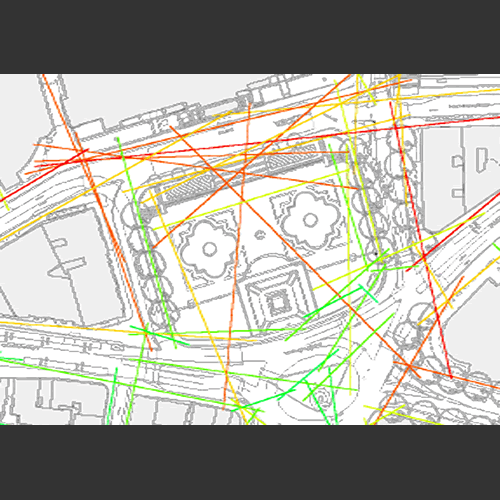
Axial maps sometimes referred to as Space Syntax is a system of mapping accessibility. It allows human behaviour, communication and interaction to be mapped in relation to Spatial layouts. It helps us understand how existing spaces are working and the potential effects of new interventions. The following images show some axial maps of Trafalgar Square when Norman Foster was asked to redesign it. They mapped different options and the best proposal was a central staircase leading from a newly pedestrianised area between the square and the National Gallery.


(images from http://www.lydiaheard.com/)
The following image from Google Earth shows how successful the space has been. As you can see its full of people.

Axial maps can show the impact of:
1. The street network on urban movement patterns and flows (Hillier and Iida, 2005),and the evolution of the local centres and sub-centres. (Hillier, 2006, 1999)
2. Spatial design on feelings of security and insecurity (Hillier 2004)
3. Urban Spatial segregation and social disadvantage (Vaughan et al 2005)
4. Spatial layouts on organisational cultures (Penn, 1999)
5. Office redesign on productivity (Bafna, 2005)
6. Museum layout on use and satisfaction (Stavroulaki and Peponis 2002, Hillier and Tzorzti 2007)
(Taken from http://www.udeworld.com/)

(images from http://www.lydiaheard.com/)
The following image from Google Earth shows how successful the space has been. As you can see its full of people.

Axial maps can show the impact of:
1. The street network on urban movement patterns and flows (Hillier and Iida, 2005),and the evolution of the local centres and sub-centres. (Hillier, 2006, 1999)
2. Spatial design on feelings of security and insecurity (Hillier 2004)
3. Urban Spatial segregation and social disadvantage (Vaughan et al 2005)
4. Spatial layouts on organisational cultures (Penn, 1999)
5. Office redesign on productivity (Bafna, 2005)
6. Museum layout on use and satisfaction (Stavroulaki and Peponis 2002, Hillier and Tzorzti 2007)
(Taken from http://www.udeworld.com/)
Wednesday, 11 February 2009
site specific architecture
 Cathedral Of Nature
 Miwok Roundhouse
Finding an example of architecture which was site specific using the natural environment was not that easy , I could of easily shown examples of our ancestors use of the land and the way they designed and built their homes, which was all land inclusive . Such as the Miwok Indians who built their homes from pine and cedar poles which were bound together with grape vine or willow, this was then covered cedar bark taken from dead trees . This way of existence treats nature as it should not taking from it but existing within it . However I wanted to try and find an example of a design from now as I said this was not easy, there were examples of buildings that Incorporated the land such as those with grass roofs or walls but none that used just the natural enforcement . The closest I came was the 'Cathedral of Nature' This was the creation of Guilano Mauri he has designed a living building. The cathedral is the same size as a real cathedral it covers 82 x 15 metres and is 12 metres high. The structures used to shape and support the cathedral will eventually rot away, by which tine the the trees will be able to support themselves. The cathedral can be found situated near Malga Costa in Italy. The design was supported by the group Arte Sella (an organisation that exhibits only natural land art) they believe that "the works come from nature they live in it and then over time return to it "
Mauri 's designs control nature bending them to form his designs however they also work with nature allowing it to continue in its growth and movement.
Sunday, 8 February 2009
Utopia/Dystopia - Social Housing Schemes
I looked at some of the big social housing schemes that started with great utopian ideals. The Hutchieson blocks in the gorbals in Glasgow, were designed by Sir Basil Spence to replace existing slums. Designed in 1959 and occupied in 1965 they consisted of 10 tower blocks linked by green space in a 15 acre space. His style of architecture was called ‘ brutalism’ and the buildings suffered from poor construction, maintenance, crime and vandalism and were demolished in 1993 - utopia turned to distopia. Byker wall in Newcastle is another famous social housing scheme designed by Ralph Erskine and built in the mid 1970s. Described as a pioneering social development, it received many awards and was listed in 2007. There are both positive and negative reports of this community - good community spirit and activities but also problems with drugs, vandalism and crime, which cause people to move away and start a downward spiral, so not quite the Utopia hoped for. I felt sure there were some successful schemes on the continent. I found one – Tinggaarden in Denmark, which was the first rental cohousing scheme. In 1971 the Danish Building Institute sponsored a competition for low rise cluster housing and the first residents moved in in 1976. Groups of apartments are built in clusters around communal areas. Its success has led to other schemes both private and rental and the government has made the funding process easier. As the schemes have evolved occupants have wanted smaller personal areas and greater communal facilities – so it does seem to have achieved a sort of Utopia and certainly looks a pleasant place to live.
www.rcahms.gov.uk/pls/portal/canmore.newcandig_details_gis?inumlink=70581
www.bbc.co.uk/tyne/content/articles/2007/01/06/byker_redevelopment_feature.shtml
www.telegraph.co.uk/news/uknews/1440088/Crime-plagued-Byker-Wall-may-win-grade-II-listing.html
www.journallive.co.uk/.../tm_headline=a-national-treasure&method=full&objectid=18512558&siteid=50081-name_page.html
www.geocities.com/kaysgeography/byker.htm
http://l.cohousing.org/dk99/DKtour.TG2.html
www.tinggaarden.nu/_70297/Sider/In+English/Living+in+Tinggaarden.htm
www.cohousing.org/cm/article/related_denmark
www.rcahms.gov.uk/pls/portal/canmore.newcandig_details_gis?inumlink=70581
www.bbc.co.uk/tyne/content/articles/2007/01/06/byker_redevelopment_feature.shtml
www.telegraph.co.uk/news/uknews/1440088/Crime-plagued-Byker-Wall-may-win-grade-II-listing.html
www.journallive.co.uk/.../tm_headline=a-national-treasure&method=full&objectid=18512558&siteid=50081-name_page.html
www.geocities.com/kaysgeography/byker.htm
http://l.cohousing.org/dk99/DKtour.TG2.html
www.tinggaarden.nu/_70297/Sider/In+English/Living+in+Tinggaarden.htm
www.cohousing.org/cm/article/related_denmark
Thursday, 5 February 2009
Dystopian Ponte tower


Ponte tower in Johannesberg is a perfect example of a utopian ideal turning into a dystopian nightmare. The tower is 173 m high containing 54 floors, accommodating 470 apartments. The building is cylindrical in shape with the central core removed. It was built in 1975, renowned as the tallest building south of the equator. It started life as a very prestigious place to live; a signature building which celebrated a new way of living. However the nightmare began in the 1990's when the tower became home to drug users, gang warfare, prostitution and a high number of suicides. The residents not only abused themselves but also the building, they would empty their rubbish into the central space, disregard any repairs leaving the elevators unfixed and unused. Many of the residents were too afraid to leave their apartments and would pay to have their food supplies delivered. This once supposedly perfect place to live had become a space/place with its own rules, shut off from the rest of the city, governed by and ruined by its own existence in trying to control how its residents lived.
Subscribe to:
Posts (Atom)